Evaluating AQG Coriolis effect measurements
The AQG measurements are influenced by the Coriolis effect.
This effect is instrument specific and has to be evaluated and estimated on a regular basis.
For this, several measurements with different instrument orientations (towards North) have to be carried out.
perform_coriolis_analysis() is a procedure to process these datasets and perform a fit adjustment for the influence (and thus provide a correction value) of the Coriolis effect.
This is demonstrated in the following.
The example data is included in data/coriolis_evaluation_data/ together with a necessary configuration file.
Regular calibration
It is important that such a Coriolis effect estimation should be carried out on a regular basis. So far it is not sure if this effect is constant in time (apmplitude, phase) for each instrument. Usually a well constrolled environment should be choses for this analysis (e.g. gravity lab).
Necessary configuration file
In order to ensure that each measurement is linked to the correct instrument orientation, we have to load a configuration file which holds this information. This is especially true for older AQG GUI versions (<2.03) where this information could not be stored.
from gravitools.utils import files_in_path
from gravitools.aqg.files import is_aqg_info
from gravitools.config import read_config
from gravitools.aqg import process_aqg_raw_dataset

path_config = "../data/coriolis_evaluation_data/config_coriolis_GFZ_AQG_B02.yml"
path_folders = "../data/coriolis_evaluation_data"

###############
## PLEASE NOTE:
# reading EOP data this way is only necessary for the documentation (due to missing local file systems)
from gravitools.corrections import read_eop_data
eop_data = read_eop_data('../data/finals2000A.all.csv')
###############

all_files = files_in_path(path_folders)

rawdata_folders = [path.parent for path in all_files if is_aqg_info(path)]
datasets = list()
for path in rawdata_folders:
    config = read_config(path_config) if path_config else {}
    datasets.append(process_aqg_raw_dataset(path, config=config))

datasets
[<AQGDataset: 20240115_084932>,
 <AQGDataset: 20240115_135537>,
 <AQGDataset: 20240115_173121>,
 <AQGDataset: 20240108_152641>,
 <AQGDataset: 20240115_095813>]
Now that all individual measurements are stored in datasets, we can perform the analysis.
from gravitools.aqg.coriolis import perform_coriolis_analysis

coriolis_analysis = perform_coriolis_analysis(datasets)
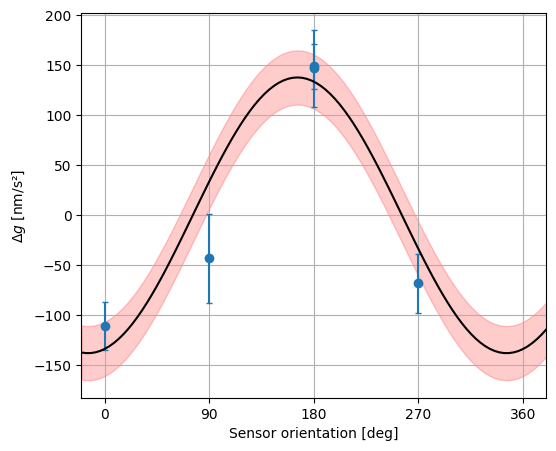
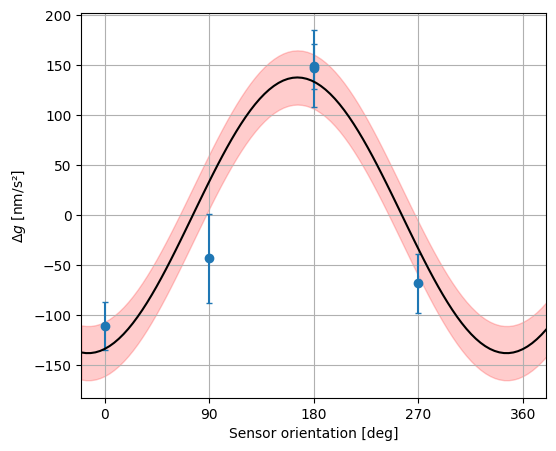
The results of the fit, providing the coriolis effect value at the instrument orientation towards 0 degree to North can be displayed.
str(coriolis_analysis)
'-133 +- 27 nm/s² at 0 degree (North)'
A plot of the fit and all processed measurement values can be shown.
coriolis_analysis.plot()
PDF report
A PDF report can be generated with all relevant information.
coriolis_analysis.save_report("../data/AQG_coriolisAnaylsis_report.pdf")
<Figure size 1360x600 with 0 Axes>